
Short-form Series | Production | International Original Content | Streaming
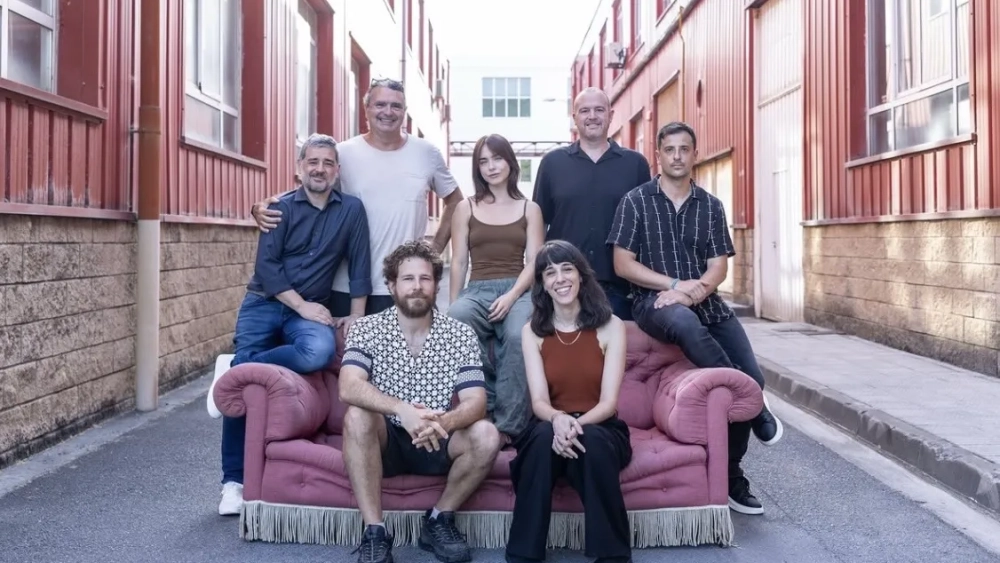
The ‘Iruña 97’ team before the start of filming: Natxo López, Clara Galle, David Pérez Sañudo, Álvaro Cervantes, and Marina Parés. (Photo: David Herranz / Movistar Plus)
- The film, produced by Buendía Estudios Bizkaia, is based on an original idea by Natxo López, co-written with Marina Parés and David Pérez Sañudo. Filming begins on July 7 and will span 15 weeks.
Movistar Plus begins filming “Iruña 97” on July 7 in Pamplona; production will continue for 15 weeks across Biscay and Pamplona. This production by Buendía Estudios Bizkaia, with the participation of Movistar Plus, is based on an original idea by Natxo López (‘Perdida’, ‘Entrevías’), co-written with Marina Parés and David Pérez Sañudo. Pérez Sañudo (‘Ane’), (‘Los Últimos Románticos’) is directing. Tomás Silberman and Pepe Ripoll serve as executive producers.
THE STORY
The series (6 x 45 minutes), set in 1997, is an action thriller. The series recreates a criminal investigation led by Amaia, a municipal police officer played by Clara Galle (‘Olympo’, ‘Ni una Más’), and Julio, a National Police inspector (Álvaro Cervantes), set against the backdrop of the San Fermín festival. The pair represents two conflicting sides of Pamplona, yet they must join forces to solve a case that proves far more complex than anticipated. Joining Clara Galle and Álvaro Cervantes in the cast are Pablo Gómez-Pando, Karra Elejalde, María Pujalte, Patxi Freytez, Josu Iriarte, Josean Bengoetxea, Itsaso Arana, Fernando Albizu, Ainhoa Santamaría, Miriam Rubio, and Paula Usero, among others.
San Fermín, 1997. An unidentified body is discovered on the city walls. Authorities dismiss it as a typical festival-related accident, but Amaia (Clara Galle), a young municipal police officer, suspects murder. Defying her superiors, she involves Julio (Álvaro Cervantes), a National Police homicide detective who has just returned to Pamplona. Despite their differences, the two join forces to investigate a case that turns out to be far more complicated than expected. They operate within a fractured city where festival euphoria coexists with the threat of terrorism—all during the year the kidnapping of Miguel Ángel Blanco changed Spanish society forever.